Need to know exactly how many gallons your pool holds? Precision matters. Whether you are dialing in your water chemistry or sizing a new pump, guessing leads to cloudy water and wasted money.
Grab your tape measure and use our custom Pool Volume Calculator below to get your exact gallon count.
Pool Volume Calculator
Select your pool shape and enter measurements in feet.
Pool Volume Reference Chart
Looking for a quick estimate? Use our reference charts below for the most common pool sizes. Keep in mind that measuring your specific pool will always yield the most accurate results for chemical dosing.
In-Ground Pools (Average Depth)
| Pool Size & Shape | Estimated Gallons |
|---|---|
| Rectangular | |
| 12x24 Rectangular | 10,800 |
| 16x32 Rectangular | 19,200 |
| 16x36 Rectangular | 21,600 |
| 18x36 Rectangular | 24,300 |
| 20x40 Rectangular | 30,000 |
| Oval | |
| 16x32 Oval | 17,200 |
| 18x36 Oval | 21,700 |
| 20x40 Oval | 26,800 |
| Grecian | |
| 17x33 Grecian | 19,700 |
| 17x37 Grecian | 22,200 |
| 20x36 Grecian | 24,300 |
| 20x44 Grecian | 30,300 |
| Kidney | |
| 16x30 Kidney | 14,900 |
| 16x34 Kidney | 16,500 |
| 20x38 Kidney | 20,200 |
Above-Ground Pools
| Pool Size (48" Wall) | Gallons |
|---|---|
| Round | |
| 15' Round | 5,300 |
| 18' Round | 7,600 |
| 20' Round | 9,400 |
| 24' Round | 13,600 |
| 27' Round | 17,200 |
| 28' Round | 18,500 |
| Oval | |
| 11x25 Oval | 6,500 |
| 15x25 Oval | 7,800 |
| 15x30 Oval | 8,900 |
| 18x33 Oval | 10,600 |
| 18x38 Oval | 14,000 |
| Pool Size (52" Wall) | Gallons |
|---|---|
| Round | |
| 15' Round | 5,800 |
| 18' Round | 8,300 |
| 20' Round | 10,200 |
| 24' Round | 15,300 |
| 27' Round | 18,600 |
| 28' Round | 20,000 |
| Oval | |
| 11x25 Oval | 7,000 |
| 15x25 Oval | 8,400 |
| 15x30 Oval | 9,600 |
| 18x33 Oval | 11,500 |
| 18x38 Oval | 15,200 |
How to Calculate Pool Volume Manually
If you prefer to run the numbers yourself, or if you have an irregular-shaped pool, here is the exact math the professionals use.
The Basic Equation
To get your pool’s volume, you need the surface area and the average depth. You will need these metrics:
- Length (L)
- Width (W)
- Depth (D)
- Diameter (d) & Radius (r) (for round pools)
The Magic Number: One cubic foot of water contains roughly 7.5 gallons. Once you find the cubic footage of your pool, you multiply it by 7.5 to get your total gallons.
Rectangular Pools
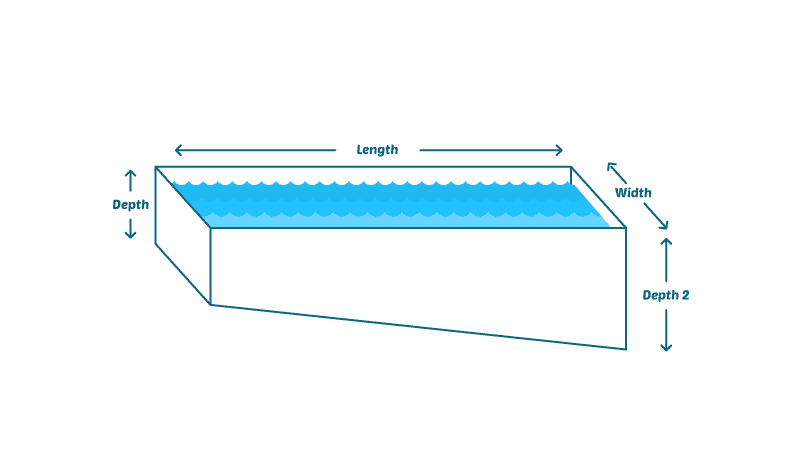
Constant Depth: L × W × D × 7.5 = Gallons
Example: A pool 32 ft long, 16 ft wide, and exactly 4 ft deep:
32 × 16 × 4 × 7.5 = 15,360 gallons.
Variable Depth (Gradual Slope): If you have a shallow end and a deep end, calculate the Average Depth first. Add the shallow depth to the deep depth, then divide by 2. Then run the standard formula.
Round Pools
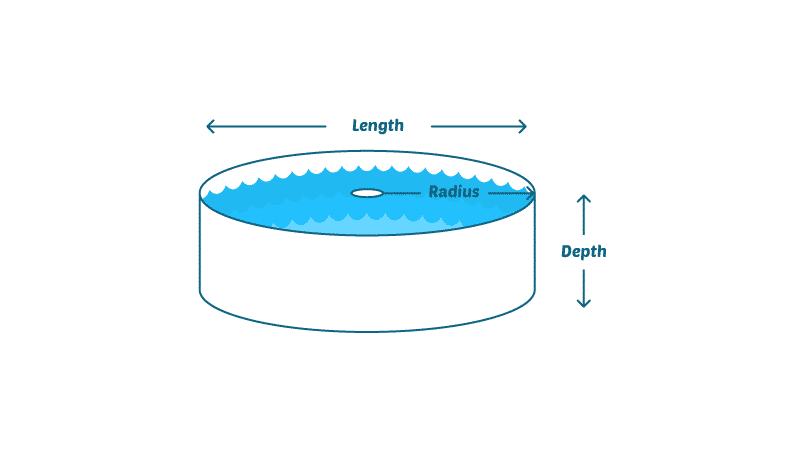
Formula: 3.14 × (Radius × Radius) × Depth × 7.5 = Gallons
Measure straight across the widest point to get your Diameter. Divide that by 2 to get your Radius.
Irregular-Shaped Pools
Kidney or freeform pools require a bit more legwork. Break the pool down into smaller, recognizable shapes (like two circles and a rectangle). Calculate the volume for each individual section using the formulas above, and add them together for your total.
Tired of Guessing? Let the Pros Handle It.
Knowing your pool volume is just step one. Balancing chemistry, upgrading equipment, and maintaining pristine water requires a system. If you want a crystal-clear pool without the weekend hassle, Pool Life is here to help.
View Our Services